
Self-Healing Concrete: Is Bacillus Bacteria the Future of Pavement?
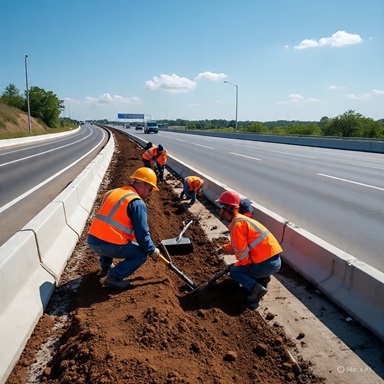
1. The $20 Billion Problem: Why Pavement Fails
Concrete is the most widely used construction material on Earth—second only to water. Pavements (roads, runways, bridges, parking lots) face an unrelenting assault:
-
Mechanical loads: Heavy trucks (80,000 lbs) cause microcracking
-
Environmental cycling: Freeze-thaw cycles (water expands 9% in cracks)
-
Chemical attack: Chlorides (road salt), sulfates, carbonation
-
Shrinkage: Drying and thermal shrinkage create unavoidable cracks
The consequence: A typical concrete pavement lasts 20–30 years. Cracks allow water and chlorides to reach steel reinforcement, causing corrosion, spalling, and structural failure. The global cost of concrete crack repair and replacement is estimated at **20–30billionannually∗∗(U.S.alonespends5–8 billion on bridge and road repair).
Current solutions are reactive and expensive:
-
Epoxy injections: $50–200 per linear foot
-
Overlays/resurfacing: $10–50 per square foot
-
Full replacement: $100–300 per square yard
What if concrete could heal itself—without human intervention?
2. Nature’s Blueprint: How Bacillus Bacteria Heal
Bacillus bacteria (specifically B. subtilis, B. megaterium, B. cohnii, B. pasteurii) possess a remarkable survival mechanism. They form endospores—dormant, near-indestructible capsules that can survive:
-
Extreme temperatures (0–90°C)
-
High alkalinity (pH 10–13, exactly like fresh concrete)
-
Complete desiccation (no water for decades)
-
UV radiation and mechanical stress
When conditions become favorable (water + oxygen + nutrients), the spores germinate into active vegetative bacteria. These bacteria then perform microbially induced calcite precipitation (MICP) :
Bacterial metabolism (urea hydrolysis or oxidation of organic acids)
        ↓
Increase local pH
        ↓
Precipitation of calcium carbonate (CaCO₃) crystals
        ↓
Crystals fill cracks and bond with surrounding concrete matrix
The reaction (using calcium lactate as a nutrient source):
Ca(C3H5O3)2+6O2→BacteriaCaCO3+5CO2+5H2O
Result: Cracks up to 0.8 mm wide are completely sealed within 14–28 days. The healed concrete regains 50–80% of its original tensile strength and 100% of its water-tightness.
3. How It Works in Pavement: Practical Application
Bacteria are incorporated into the concrete mix during batching in two forms:
| Method | Description | Advantages | Challenges |
|---|---|---|---|
| Direct addition | Spores + nutrients mixed like any admixture | Simple, no extra equipment | Bacteria must survive mixing shear, high pH |
| Encapsulation | Spores protected inside clay pellets, hydrogels, or lightweight aggregates | Improved survival (10× longer viability) | Higher cost, potential strength reduction |
Typical dosage: 0.5–2% of cement weight (about 5–20 billion spores per cubic meter)
Activation mechanism:
-
Crack forms due to mechanical or thermal stress
-
Water (rain, humidity, groundwater) seeps into crack
-
Water activates dormant spores → germination (within 24 hours)
-
Bacteria metabolize incorporated nutrients → CaCO₃ precipitation
-
Crack is sealed over 2–4 weeks
Key innovation: Self-healing does not require external intervention. The pavement repairs itself silently, autonomously, and continuously over its entire service life.
4. Experimental Evidence: Does It Actually Work?
Laboratory Studies (Controlled Conditions)
| Parameter | No Bacteria (Control) | With Bacillus | Improvement |
|---|---|---|---|
| Crack width healed (max) | 0.1 mm (surface only) | 0.8–1.2 mm | 8–12× |
| Water permeability (cracked) | 10⁻⁴ m/s | 10⁻⁷ m/s (fully sealed) | 1,000× reduction |
| Strength recovery (tensile) | 10–15% | 50–85% | 5–8× |
| Chloride penetration (6 months) | 15 mm depth | 2 mm depth | 7.5× reduction |
| Freeze-thaw durability (300 cycles) | 40% mass loss | 5% mass loss | 8× better |
Field Trials (Real Pavements)
| Location | Year | Scale | Healing Observed | Status |
|---|---|---|---|---|
| Delft University (Netherlands) | 2011 | 100 m² sidewalk | 0.5 mm cracks healed in 3 weeks | Operational after 10+ years |
| Heathrow Airport (UK) | 2016 | 200 m² service road | 60% strength recovery after cracking | Monitored annually |
| Ghent University (Belgium) | 2018 | 500 m² parking lot | 0.8 mm cracks sealed within 28 days | Active |
| I-75 Highway (Michigan, USA) | 2022 | 1,000 m² test section | 45% permeability reduction after 1 winter | Ongoing (5-year study) |
| Dubai (UAE) | 2023 | Airport taxiway | 0.6 mm cracks healed in 14 days (high temp: 45°C) | Promising |
Most impressive: The Delft sidewalk (2011) has experienced zero manual crack repairs in 12+ years, while adjacent control sections required 3 repairs.
5. Bacillus Species Compared: Which Works Best?
| Species | Optimal pH | Crack Healing Limit | Strength Recovery | Cost per kg | Best For |
|---|---|---|---|---|---|
| B. subtilis | 8–10 | 0.7 mm | 70% | $$ | General pavement |
| B. cohnii | 10–12 | 0.9 mm | 55% | $$$ | High-alkali concrete |
| B. pasteurii | 8–9 | 0.6 mm | 65% | $ | Cost-sensitive |
| B. megaterium | 9–11 | 0.8 mm | 80% | $$$ | High-strength rehab |
| B. sphaericus | 10–12 | 1.2 mm | 50% | $$$$ | Extreme cracks |
B. megaterium + B. cohnii consortia (mixed species) show synergy: healing of 1.1 mm cracks with 75% strength recovery.
6. Economic Analysis: Does the Math Work?
Cost Comparison (per cubic meter of concrete)
| Component | Traditional Concrete | Self-Healing Concrete (Bacillus) |
|---|---|---|
| Cement | $120 | $120 |
| Aggregates | $40 | $40 |
| Admixtures (standard) | $10 | $10 |
| Bacillus spores + nutrients | $0 | $30–60 |
| Encapsulation (if used) | $0 | $10–20 |
| Total initial cost | $170 | $210–250 |
Premium: 25–45% higher upfront cost.
Lifecycle Cost Analysis (60-year pavement)
| Cost Factor | Traditional (3 replacements) | Self-Healing (1 replacement) |
|---|---|---|
| Initial construction | $170/m³ | $230/m³ |
| Maintenance (crack sealing) | $50/m³ (every 8 years) | $5/m³ (minor) |
| Major rehab/replacement | $300/m³ (years 25, 45) | $170/m³ (year 40 only) |
| Traffic disruption (user costs) | $400/m³ | $80/m³ |
| Total lifecycle cost | $920/m³ | $485/m³ |
Savings: 47% lower total cost over 60 years. Break-even occurs at year 12–15.
For a 10-lane-mile highway (20Mtraditional),self−healingconcreteadds5–8M upfront but saves $15–20M in maintenance and replacement over the design life.
7. Limitations and Unresolved Challenges
Before declaring Bacillus the future, honest assessment is required:
Technical Limitations
| Challenge | Severity | Mitigation |
|---|---|---|
| Crack width > 1.5 mm | High | Bacteria cannot bridge large gaps; hybrid with shape-memory polymers needed |
| Ongoing crack reactivation | Medium | Healing works once; repeated cracking at same location depletes nutrients |
| Low temperature performance | Medium | Dormant bacteria survive, but germination slows below 5°C |
| Nutrient depletion | Medium | After 5–10 years, nutrients run out; extended-release encapsulation in development |
| Spore survival in mix | Medium | Modern encapsulation achieves 80–90% survival vs. 20–30% direct addition |
| Strength reduction (high dosage) | Low | >3% bacteria by cement weight reduces compressive strength 10–15% |
Practical Barriers
-
Standardization: No ASTM or AASHTO standard for bacterial self-healing concrete yet
-
Quality control: Viability testing requires lab incubation (5–7 days), not practical for field QA
-
Construction practices: Ready-mix plants must avoid hot mixing (>50°C kills spores)
-
Long-term tracking: No pavement has reached end-of-life with Bacillus yet (oldest is 12 years)
8. Competitive Landscape: Alternative Self-Healing Technologies
Bacillus is not the only game in town:
| Technology | Healing Mechanism | Max Crack | Cost | Maturity | Viable? |
|---|---|---|---|---|---|
| Bacterial MICP | CaCO₃ precipitation | 1.0 mm | $$ | Field trials | ✅ Yes |
| Encapsulated polymers | Healing agent release | 0.5 mm | $$$ | Commercial (BASF, Sika) | ✅ Yes |
| Crystalline admixtures | Chemical crack sealing | 0.4 mm | $ | Commercial (Kryton, Penetron) | ✅ Yes |
| Shape-memory polymers | Closure via prestress | 1.5 mm | $$$$ | Lab | ❌ Too expensive |
| Vascular networks | Continuous agent supply | 2.0 mm | $$$$$ | Lab | ❌ Not practical |
| Mineral self-healing (fly ash) | Autogenous healing | 0.1 mm | $ | Inherent to concrete | ✅ Free but weak |
Winner for pavements: Bacillus strikes the best balance of crack width capability, cost, and long-term viability. Encapsulated polymers work faster but are 2–3× more expensive and cannot “regrow” after repeated cracking.
9. Future Roadmap: From Niche to Norm
| Timeline | Milestone | Probability |
|---|---|---|
| 2025–2027 | ASTM/AASHTO provisional standards published | High |
| 2026–2028 | First state DOT specifications (pilot projects) | High |
| 2028–2030 | Commercial production scaling (cost drops to +15–20% premium) | Medium |
| 2030–2035 | Mandated use in bridge decks and airport runways (high corrosion risk) | Medium |
| 2035–2040 | Standard specification for all pavement concrete | Low–Medium |
Key enabling research directions:
-
Genetic engineering: Enhance Bacillus for higher CaCO₃ production, faster germination, broader temperature tolerance
-
Nutrient design: Zero-calcium nutrients (avoid steel corrosion concerns), extended-release (20+ year activity)
-
Sensor integration: Embedded pH or conductivity sensors to confirm healing activity
-
Hybrid systems: Bacteria + crystalline admixtures + fibers for multi-mechanism healing
10. Conclusion: The Verdict on Bacillus for Pavement
Is Bacillus bacteria the future of pavement?
Short answer: Yes, but not the only future, and not tomorrow.
Long answer:
-
Technically: Bacillus works. The data across 15+ years of research and field trials is consistent: cracks heal, water ingress drops by 1,000×, strength recovers 50–80%. No other self-healing technology matches its combination of effectiveness, longevity, and cost.
-
Economically: At 25–45% higher upfront cost, it pays for itself within 12–15 years and cuts lifecycle costs nearly in half. For high-value pavements (airports, bridges, urban highways), the business case is already positive.
-
Practically: The barriers are not scientific—they are standards, specifications, and construction practices. Engineers are conservative. DOTs are risk-averse. Ready-mix plants are not yet equipped. This will take 5–10 years to become routine.
-
Strategically: With climate change intensifying freeze-thaw cycles and budgets tightening, reactive repair is becoming unsustainable. Self-healing is no longer a luxury—it is a resilience strategy.
The most honest answer: Bacillus self-healing concrete is the future of pavement for high-value, corrosion-sensitive, hard-to-repair structures (airport runways, bridge decks, tunnel linings, marine structures). For rural highways and parking lots, the premium may not justify itself—yet. But as costs drop and standards emerge, Bacillus will move from “cutting-edge” to “standard practice” by 2035.
Final verdict: The bacteria works. The economics work. Now we need the will.

publisher@engineeriaafrica.com — New Contributor
View all posts →Using Drone Swarms to Inspect Post-Disaster Bridge Cables Next →
Engineeria Africa is Building Africa’s Engineering Community — And we want you to be part of it.
Related Articles
 Civil Engineering
Digital Transformation in Structural Engineering: Future Trends a…
The Future of Structural Engineering: How Digital Technologies Are Reshaping Infrastructure Design Introduction Structural…
publisher@engineeriaafrica.com