
AI Revolutionizing Construction in Africa
AI Revolutionizing Construction in Africa
How Artificial Intelligence is Reshaping the Future of African Infrastructure
By Editorial Team, Engineeria Africa
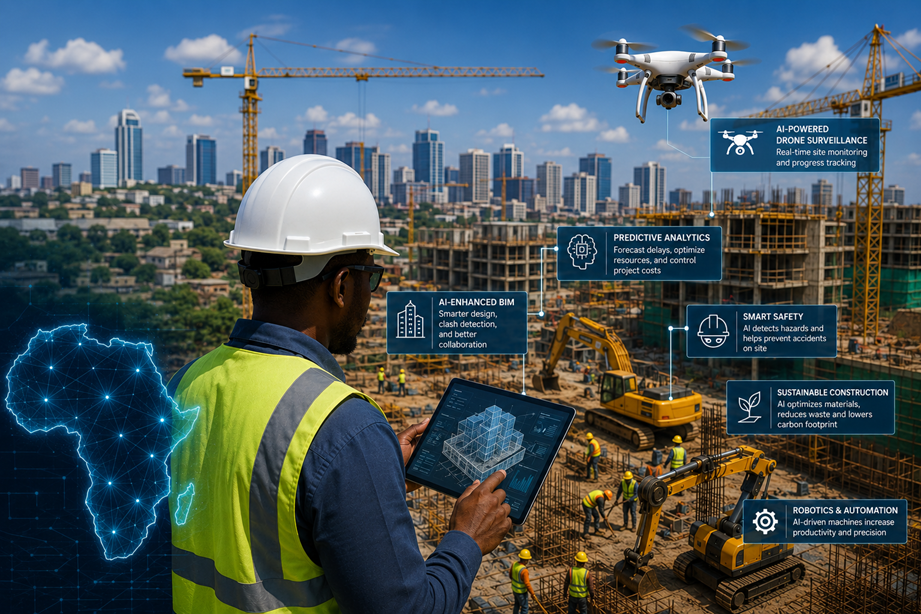
Across Africa, the construction industry is undergoing a remarkable transformation. Traditionally characterized by labor-intensive processes, project delays, cost overruns, and safety challenges, the sector is now embracing a new era powered by Artificial Intelligence (AI). From automated design tools and predictive analytics to smart project management systems and robotics, AI is rapidly redefining how infrastructure is conceived, designed, and delivered across the continent.
The Rise of AI in African Construction
Africa’s rapid urbanization has created an urgent need for roads, housing, bridges, rail systems, power infrastructure, and smart cities. With urban populations projected to increase significantly over the coming decades, construction firms are increasingly turning to AI-driven solutions to meet growing demands efficiently.
Artificial Intelligence refers to computer systems capable of performing tasks that typically require human intelligence, such as learning, problem-solving, prediction, and decision-making. In construction, these capabilities are being applied to optimize workflows, reduce waste, enhance safety, and improve project outcomes.
AI Applications Transforming Construction
1. Smart Project Planning and Management
Project delays remain one of the largest challenges facing construction projects in Africa. AI-powered project management platforms now analyze historical project data, weather conditions, labor availability, and material supply trends to predict delays before they occur.
These systems help project managers:
- Forecast project completion times
- Optimize workforce allocation
- Predict budget overruns
- Improve scheduling efficiency
By reducing uncertainty, contractors can make faster and more informed decisions.
2. Building Information Modeling (BIM) Enhanced by AI
Modern construction increasingly relies on digital building models. AI-enhanced BIM systems can automatically detect design conflicts, optimize material use, and simulate construction sequences before physical work begins.
Benefits include:
- Reduced design errors
- Improved collaboration among stakeholders
- Lower material wastage
- Faster project delivery
AI-powered BIM is especially valuable in large infrastructure projects where coordination is complex.
3. Drones and Computer Vision for Site Monitoring
Construction firms across Africa are adopting drones combined with AI image analysis to monitor project sites.
These technologies help engineers:
- Track project progress in real time
- Identify safety hazards
- Measure earthworks volumes
- Conduct inspections in dangerous locations
This reduces manual surveying costs while improving accuracy and worker safety.
4. Predictive Maintenance for Infrastructure
AI is not only changing how projects are built—it is also improving how infrastructure is maintained.
Machine learning models can analyze sensor data from bridges, highways, and buildings to predict structural deterioration before failures occur.
Applications include:
- Bridge health monitoring
- Pavement deterioration prediction
- Water pipeline leak detection
- Building condition assessment
This proactive approach extends infrastructure lifespan and reduces maintenance costs.
AI and Sustainable Construction
Sustainability has become a major priority for African infrastructure development. AI contributes by optimizing resource utilization and reducing environmental impact.
Examples include:
- Optimizing concrete mix proportions
- Reducing material waste
- Improving energy efficiency in buildings
- Enhancing renewable energy integration
Smart construction practices powered by AI can significantly reduce carbon emissions while improving project economics.
Challenges Limiting Adoption
Despite its potential, several barriers continue to slow AI adoption across Africa:
Limited Digital Infrastructure
Many regions still face inadequate internet connectivity and unreliable power supply, restricting deployment of AI-driven systems.
Skills Gap
The shortage of professionals trained in AI, data science, and digital construction technologies remains significant.
High Initial Costs
Advanced technologies often require substantial upfront investments, making adoption difficult for smaller firms.
Data Availability Issues
AI systems require large volumes of quality data, which is often unavailable or poorly managed.
Emerging Opportunities for African Engineers
The AI revolution presents enormous opportunities for engineers, researchers, and students.
Skills likely to become increasingly valuable include:
- Machine learning applications in engineering
- Data analytics
- BIM technologies
- Programming for engineering applications
- Automation and robotics
Universities and training institutions are beginning to integrate these competencies into engineering education to prepare future professionals.
The Road Ahead
Artificial Intelligence is no longer a futuristic concept—it is already reshaping construction practices across Africa. While challenges remain, the benefits of improved efficiency, safety, sustainability, and cost savings make AI adoption inevitable.
For African engineers, embracing digital transformation is becoming less of an option and more of a necessity. The future construction professional may need to combine traditional engineering expertise with data-driven decision-making and AI literacy.
As cities expand and infrastructure demands increase, AI may ultimately become one of the most important tools for building Africa’s future.
Key Takeaway:
The construction industry in Africa is entering a new digital era where AI-powered technologies are helping engineers build smarter, faster, safer, and more sustainably than ever before.

publisher@engineeriaafrica.com — New Contributor
View all posts →AI Tools for Engineers Next →
Beyond the Hype: How Graph Neural Networks Are Solving Mesh-Based Simulations